Friday, June 30, 2006

Keith Green and "Spiritual Abortion"

I would venture to say that few people influenced my generation (I am 45) for world missions more than Contemporary Christian Music artist Keith Green. Still today, I am continually meeting people on the mission field who credit a big part of their call to missions to the influence of Keith Green. I remember clearly the privilege of seeing him live in concert in Austin, Texas, just a few months before his tragic death at the age of 28, in an airplane crash, together with 2 of his children, in the year 1982.

Keith Green had a passion and authenticity in the Lord’s work matched by very few. The vision is still clearly etched in my mind of the moment that evening in Austin, as he was singing his classic song Grace By Which I Stand, when he came to the line "And like Peter, I can’t even watch and pray for just one hour, and I bet, I could deny you too," and he literally broke down and cried, and was unable to finish the rest of the song.

Keith Green was also known as a fiery prophet, speaking his convictions without mincing words. As we continue to think about evangelism, I want to draw your attention to something Keith Green wrote in a pamphlet entitled What’s Wrong with the Gospel?, in which, in addition to some other subjects, he discussed the concept of what he called "spiritual abortion."


As with the altar call, the practice of having someone repeat a prayer with the minister probably originated from the best of intentions. And no doubt, there are those who have "followed through," continuing to pray and walk with God, entering into the path of righteousness through God's infinite grace. But also, like the altar call, the so-called "sinner's prayer" is one of those tools that make it alarmingly easy for someone to consider himself a Christian, when he has absolutely no understanding of what "counting the cost" (Luke 14:28) really means.

The greatest reason I believe that God can be grieved with the current use of such tools as the "altar call" and "sinner's prayer" is because they can take away the conviction of the Holy Spirit prematurely, before the Spirit has time to work repentance leading to salvation. With an emotional splash that usually doesn't last more than a few weeks, we believe we're leading people into the Kingdom, when really we're leading many to hell - by interfering with what the Spirit of God is trying to do in a person's life. Do you hear? Do you understand that this constitutes "spiritual abortion"? Can't you see the eternal consequences of jumping the gun, trying to bring to birth a baby that isn't ready?

We are so afraid that we'll see a "big one that got away," that we'd rather rush someone into a shallow decision, and get the personal gratification of seeing him "go down the aisle," than take the time to fully explain things to him, even if it takes long hours and nights of travailing prayer for his soul. We just don't "have the time" to do things God's way anymore.

But God would rather see one true convert than an ocean full of "decisions." Oh, can't you see what a mess we're in? What we've done to the Gospel? And when those "converts" no longer want to fellowship with us, when they want to go back to their old friends and their old way of life, we have the nerve to call it "backsliding," when we stood in the very way of them ever "front-sliding" toward the cross! Oh, it breaks my heart to think of that awesome day when God will judge those who have "stumbled one of these little ones." (Mark 9:42)

I am painfully aware of the danger of being so concerned of the dangers of "spiritual abortion" that we never get to the point of bringing new Christians to a healthy birth. I am personally convicted that I don’t do near enough to cultivate redemptive relationships with lost people with the hope of one day leading them to surrender their lives completely to Christ. But, as we as Southern Baptists make a greater push, both around the world, and in the States, to lead more people to Christ, and baptize more converts, I think we would do well to heed the warnings of Keith Green, lest in working harder, we begin to see diminishing returns for our work, and are unable to figure out the reason why.

Wednesday, June 28, 2006

Missionary Strategy and Hermeneutics

This post is more about questions than answers.

A poster with the blog name of “mr. t”, who, on his blog, on mission, identifies himself as a fellow missionary in South Asia, left a couple of comments on my last two posts about evangelism, referencing the missionary strategy given by Jesus to his disciples in Matthew 10 and Luke 10 regarding finding a “man of peace” and staying in that same house, rather than going from house to house.

Let me say right off, I am not looking to “pick a fight” with “mr. t”. In fact, I went to his blog, and absolutely loved what all he has to say. I highly recommend it. However, his recent comments, which are representative of a good bit of recent thinking by quite a few missions strategists, bring up some questions in my mind that I think are worthy of discussion.

The basic idea is that, as church planters, our main goal upon arriving in a new city, town, or people group, is to identify the “person of peace.” Once we find that person, who will many times be our first disciple, he or she will become the key to reaching the rest of the city, town, or people group. “Mr. t” makes the additional assertion that he believes “there are those persons of peace and worthy households out there among every people.” It is basically a matter of persevering until we find them.

For a good many contexts around the world, I believe this is great missiology. God is blessing it, people are being saved, and churches planted. However, as a foolproof, cookie-cutter, promise from Scripture, I have my doubts as to its hermeneutical validity.

First of all, many who use these passages as their strategy guide conveniently omit the part about not taking along “a purse, or bag, or shoes.” Some also by-pass the part about healing the sick. But my main concern here has to do with the part about “shaking the dust off your feet.” I honestly don’t know how to transfer the biblical principle here to our modern-day missionary context. I mean, it seems like the disciples knew pretty soon when it was time to leave town and shake the dust off their feet. Both William Carey and Adoniram Judson went 7 years each before baptizing their first convert, though.

Some make reference to the worshippers “from every nation, tribe, people and tongue” gathered around the throne in the book of Revelation, and say we thus have biblical warrant to expect a positive response to the preaching of the gospel from every people group segment. While this idea is appealing to me, I can’t help but wonder about various entire people groups from the Old Testament who in the last days were to be the objects of God’s wrath. And what about Bethsaida, Chorazin, and Capernaum in the New Testament (Luke 10:13-15)? I’ve always wondered how we specifically define nations, tribes, peoples and tongues. John Piper does as good a job with this as anyone in Let the Nations be Glad. But he still doesn’t answer some of my questions. What about, for example, entire generations of people groups in the Dark Ages without one person who we would today call an “evangelical believer”?

Then there are those who point to the supposed missionary strategy of Paul, stating he had the habit of staying in towns just enough time to preach the gospel, gather a few converts, name elders among them, and then leave—all in a period of a few days or weeks. My impression, upon reading Acts, is a bit different. I see Paul, towards the end of his missionary ministry, after he had learned some important lessons, staying on 3 years in Ephesus, setting up his ministry training school at the Lecture Hall of Tyrannus, and having more strategic impact there than anywhere else in his previous travels. I also see New Testament “missionaries” like Timothy and Titus, going back to places where Paul had been, in order finish the work he had started.

What’s my main point in all of this? In missions, one size does not fit all. Different situations and different spiritual and cultural contexts demand different strategical approaches. There is a time to reap. But there is also a time to plow, a time to sow, and a time to water. And even perhaps a time to “shake the dust off your feet.”

Sunday, June 25, 2006

Hard Soil

A few years ago, a colleague and friend of mine, who was a missionary at that time in the city of Ibi, Spain (pop. 20,000), over a period of several years, knocked on every door in the city of Ibi at least twice, and in some cases three times, with the intent of sharing the plan of salvation to those who came to the door. When I first heard of this, I was amazed, and I continue to be amazed at the boldness, faithfulness, and dedication of this dear brother in Christ.

After several years of doing this, my colleague shared with me that he had not seen one person give their heart to Christ as a result of his efforts. Upon arriving in Ibi, he did not know of one single evangelical believer in town, and upon leaving, several years later, he still did not know of one single evangelical believer.

In a technical sense, you could say what my friend was doing was “sowing”. He was literally “spreading the seed” of the Gospel.

In the city of Mérida (pop. 50,000), where my wife and I worked for 5 years, we began in a similar situation to that of my friend in Ibi, though there were a handful of believers in town. For the first couple of years, we did (with the help of a number of other people) extensive literature distribution, open-air preaching, and door-to-door work, lending videos of the Jesus film. However, we saw no real response from these “sowing” attempts. A few years later, though, we were blessed to be able to leave a congregation of about 25 baptized believers, and an average Sunday morning attendance of about 70, in the hands of a team of local leaders.

The difference? First of all, I would point to the sovereign grace of God, who chooses to work whenever and wherever He wills. Next, I would point to massive efforts in prayer, through various prayer-walking teams, and other methods of prayer mobilization. Finally, I would point towards personal relationships, social ministry, and pastoral care of needy and hurting people, which are the areas from which we saw the most fruit during our time there.

Why am I making this comparison? To build myself up, and cut my friend down? By no means. If rewards in heaven are based on our faithfulness here on earth, I am pretty sure he will have more than me. Compared to many contexts in other parts of the world, neither one of us saw much fruit from our labors.

But I do think there are some lessons to be learned in regard to how we approach evangelism in different contexts. Following the agricultural analogy, it is often necessary to “plow” the ground, and add “fertilizer” to it before spreading valuable seed on hard, unproductive ground.

Jesus, in the Parable of the Sower, tells us there are different types of soil. In a “micro” sense, I believe the soil is the hearts of individuals. But in a “macro” sense, I believe it is also true that the soil is the cultural context in which we live and work. And, for some reason, there appear to be some “cultural context soils” where it is a lot more difficult to find “individual heart soils” ready to receive a “one-off” Gospel presentation, and respond positively, than others.

Some would point out that the sower in the parable spread the seed in all different kinds of soil. But I wonder whether, in unproductive, hard soil, there is something better we can do than just “spread seed”. Matthew 13:23 says “But the one who received the seed that fell on good soil is the man who hears the word and understands it.” I think that individuals’ understanding of the Gospel is often clouded by their cultural context. We can help to “plow” and “fertilize” the “soil” of their hearts, first and foremost, by prayer, and next, by building personal relationships, and seeking to understand their cultural context better, in order to make sure the message we are intending to communicate is really the message that they are “understanding”.

Thursday, June 22, 2006

Ripe for Harvest?

I tell you, open your eyes and look at the fields! They are ripe for harvest. Even now the reaper draws his wages, even now he harvests the crop for eternal life, so that the sower and the reaper may be glad together. Thus the saying ‘One sows and another reaps’ is true. I sent you to reap what you have not worked for. Others have done the hard work, and you have reaped the benefits of their labor. John 4.35-38

We have been told that baptisms are down in the Southern Baptist Convention. We have been told we need to re-double our efforts in witnessing. We have been told the reason for the decline is our lack of commitment and relaxed attitude toward soul-winning. Some have suggested that perhaps we need to tweak our methods.

PLEASE HEAR ME CLEARLY!!! I AM NOT AGAINST ENCOURAGING OUR PEOPLE TO BE MORE FAITHFUL IN THEIR EVANGELISTIC EFFORTS! AND I AM NOT AGAINST WORKING TO IMPROVE OUR METHODS IN COMMUNICATING THE GOSPEL MESSAGE!

However, I am not so sure that lack of evangelistic zeal or poor witnessing techniques are mostly to blame for the decline in baptisms.

No one in their right mind would call Western Europe, or more specifically Spain, where God has given me the privilege of serving Him for the last 16 years, a great "harvest field." Several years ago, I came across the little book Sowing, Reaping, Keeping, written by Lawrence Singlehurst, Director of Youth With a Mission, England. In this amazingly simple yet profound book, Singlehurst cogently makes the point that evangelism is made up not only of "reaping", but also of "sowing" and "keeping". And, in order to be most effective at the evangelistic task, it is necessary to analyze the context in which one finds oneself, and adapt the strategy accordingly. Upon my recommendation, the IMB Western Europe leadership has since made Sowing, Reaping, Keeping required reading for all new missionaries to Western Europe.

Another book with a similar message is Finding Common Ground, by Campus Crusade for Christ worker Tim Downs. I cannot recommend these two books strongly enough. In order to capture the force of the arguments made, you must get the books and read them for yourself.However, in light of recent admonitions to re-double our efforts at harvesting in the context of Southern Baptists in the United States, I want to leave you with some choice quotes from Finding Common Ground...

Many of our modern churches and evangelistic movements were founded during a time when the American fields were abundantly white for harvest. But the fields of the fifties and sixties, like the fields of Jesus’ time, were ripe for harvest because of countless sowers who had worked to create a soil that was conducive to the growth of the gospel. The "soil" of our society is the whole environment in which Christians seek to live and minister. It is the culture, the atmosphere, the worldview, the zeitgeist—the "spirit of the time" in which we live. In each generation, Christians must attempt to plant the seed of the Word of God in the soil of the prevailing culture. Historically, some soils have been better than others. In each case, the nature of the soil determines what kind of life it will support…

There is no doubt that the soil of our society has eroded significantly in a short period of time. Over the last forty years, many para-church organizations and churches have struggled with a thinning harvest in America. In an attempt to recapture the glory of past harvests we have recruited more harvesters, sharpened our sickles and scythes, and challenged our workers to greater commitment and longer hours.

Maybe it’s time to analyze the soil. Maybe it’s time to sow. (pp. 16-17)

Almost thirty years ago, as a young college student and a very new Christian, I was trained in the basic principles of evangelism. I learned to present the gospel using a simple tract, the Four Spiritual Laws. I discussed that little booklet with roommates, fraternity members, grad students, international students, and even professors. I presented the gospel to literally hundreds of people during my four years of college, and I found a tremendous amount of openness—even eagerness—to discuss spiritual things. In those days, I could assume the openness of the average hearer. My sole filter when considering a potential listener was, "Are you busy?" Today, many Christians attempting to do evangelism find that they now must assume the disinterest, or even the hostility, of the average hearer. As a result, the statistics on evangelistic success from most ministries are much lower than they were thirty years ago.

What accounts for this change? Our first instinct has been to examine ourselves. Have we lost our first love? Are we lacking in dedication or commitment? Are we as bold as we used to be? Our second response has been to reconsider our methodology. Is this booklet out-of-date? Are we behind the times? Should we expand this, enlarge this, reprint it in four-color, or make it available on CD-ROM? The option we rarely consider—perhaps because it sounds unspiritual—is that times have changed. Perhaps our nation has entered a different phase of the harvest cycle. Perhaps our culture’s fields are not as ripe as they used to be.

In John 4, Jesus uttered His famous words, "I tell you, open your eyes and look at the fields! They are ripe for harvest" (v. 35 NIV). Christians have often assumed that Jesus was stating a timeless spiritual principle: Now that the Messiah has come, a new era has begun. The fields will always be white for harvest. Is that what Jesus was saying? If so, He picked a strange metaphor. In actual farming, a time of harvest is followed by a time of rest, followed by a time of sowing, and the process begins all over again. In farming, no field is always ripe for harvest Was Jesus telling us that His fields were different, in that they were always ripe? Or was He tellling His disciples something about the day in which they lived? "But when the fullness of the time came," Galatians tells us, "God sent forth His Son…" (4:4). Much has been written about the "fullness of the time" and why the Messiah came when He did. Could it be that a part of the "fullness of the time" was that the fields of Jesus’ time had been throroughly sown and were now abundantly—perhaps uniquely—ripe for harvest? (pp. 102-03)

Let me state my concern plainly. Because we enjoyed such evangelistic success in the sixties, we told ourselves that the American fields would always be white for harvest. Because harvesting was so effective, we told ourselves that harvesting was the only technique we would ever need. If the fields are eternally ripe, we only need to harvest. Why bother with anything else?

So we teach each new generation of Christians how to harvest—only how to harvest—and we assure them that the fields around them are ripe and ready for the picking, if only they will have the faith and the boldness to go. Our books and our training videos are loaded with illustrations that show how easy it is and how open people are to hearing the gospel. But when they go, they sometimes have a rude awakening. The fields around them do not always seem ripe. People are not as eager and open as they expected—sometimes they’re even hostile. And so, because harvesting is all they know how to do, they begin to withdraw from the fields. (p. 105)

Wednesday, June 21, 2006

Denominational Idolatry Reproved

I invite you to check out the following post on Strange BaptistFire referencing the Introductory Sermon to the Georgia Baptist Convention in 1859 by C. D. Mallary, as published recently in the Winter 2006 Founders Journal.

Denominational Idolatry Reproved

It is interesting, refreshing, and confirmatory for me to see that Mallary was saying much the same things back in 1859 that I have been trying to communicate for the last several months on various posts on this blog.

Monday, June 19, 2006

Joyce Rogers Testimony Video Clip


For those of you who either missed it, or would like to see it again, here is the link for the video clip of my Mom's testimony and tribute to my Dad at the Pastors Conference at the recent Southern Baptist Convention in Greensboro.

Joyce Rogers Testimony Video Clip

Friday, June 16, 2006

The Blessings of Blogging

If you had told me a year ago that I would be into blogging now, I probably wouldn’t have believed you. But for me, this "adventure into blogging" these past months has been one of the most positive developments of my life.

Blogging for me is a lot like journaling, with the main exception that it is open for the public to see. I have always thought that someday I might like to write, but until I started blogging, never really knew where to get started. Having a blog has finally given me an excuse to put down into words ideas about which I have thought for a long time, but had never gotten around to writing down.

Another blessing of blogging is the "blogging community." Through reading others’ blogs, and commenting on them, and from interacting with those who comment on your blog, you begin to build relationships with people who share common interests. You meet and interact with people in other parts of the world, with whom you would most likely never have interacted otherwise.

Just as "iron sharpens iron," the comments of readers and other bloggers, whether supportive or antagonistic, help you to refine your ideas, and to think through issues in new ways. When you write something on your blog, and you leave the comments section open, you had better be prepared to defend yourself in the "marketplace of ideas."

At the recent Southern Baptist Convention in Greensboro, I was able to meet a good number of people in the "blogging community," who, up to that time, had been just a name, or at most, a photo on the screen, for me. People like Micah Fries, Paul Fries, John Stickley, Alan Cross, Tim Sweatman, Jeff Young, Wes Kinney, Travis Hilton, Kiki Cherry, Bowden McElroy, Jason Helmbacher, Wyman Dobbs, David Phillips, Art Rogers, Marty Duren, Kevin Bussey, Steve McCoy, Joe Thorn... Through blogging, I was able to renew contact with my old college friend, Wade Burleson, and his dad, Paul Burleson. I also discovered that because of blogging, other people knew me. A number of people I had never met, as well as a few I had met before, told me they were reading my blog.

Through blogging, it is also possible to influence others. Although it is almost impossible to estimate to what extent, many have suggested that the influence of bloggers played a major role in the election of Frank Page as President of the Southern Baptist Convention. It is the hope of many that blogging might be able to have a positive influence in the adoption of policies at the International Mission Board, which in turn might have an influence in winning a lost world to Christ.

During one of the sessions at the recent SBC, it was suggested that blogging takes away time from other more important things, such as evangelism and missions. My personal experience has been that those who are involved in blogging are often the most passionate about evangelism and missions. They blog precisely because they feel deeply about things, and feel the need to communicate their ideas and feelings to others. While it is true that it is possible to get so engrossed in blogging that you neglect other areas of your life, the same is true about any number of other activities in which we engage. The problem is not blogging, but rather lack of discipline.

It is also possible to be irresponsible with what you write on your blog. While there is plenty of room for good-natured humor, the temptation to be sarcastic and biting is all too near when writing about others who are not there in front of you at the time. It is possible to start false rumors based upon innuendo or unsubstantiated claims. However, as previously mentioned, whenever you do this, if you leave the comments section open, you had better be ready to defend yourself.

In actuality, I believe that overall, the openness and vulnerability of an interactive blog provides a good, healthy setting for developing Christian community. There is a lot of exhortation, sharing of concerns and needs, confession of weaknesses, and general encouragement that happens on many blogs. There is also rebuke and correction. Through it all, friendships are developed, and people’s lives are built up and edified.

I, for one, am thankful for the blessing of blogging.

P.S. While preparing this post, I just discovered this over at OK Preacher’s Christian Resource Center blog, referencing the original post at Under the Acacias. I think these are some excellent guidelines to keep in mind while blogging…

1. Do not let any unwholesome talk come out of your blog, but only what is helpful for building others up according to their needs. (Eph 4:29)

Is what comes from our blogs wholesome? Is what we are writing helpful for building others up? Or does it tear them down?

2. Blog about others as you would have them blog about you (Lk 6:31)

The golden rule. If we blog about others, do we do it with love, respect, and integrity?

3. But in your blogs set apart Christ as Lord. Always be prepared to give an answer to everyone who asks you to give the reason for the hope that you have. But do this with gentleness and respect, keeping a clear conscience... (1 Pet 3:15,16)

Are we consciously allowing Jesus Christ to rule over our blogs? When people disagree with us, do we respond with gentleness and respect?

4. Each one should use whatever blog he has received to serve others, faithfully administering God's grace in its various forms (1 Pet 4:10)

Are we using our blogs to serve others? To encourage, stimulate, and help others? To build them up in Christ? Or to blow our own trumpet?

5. Let us therefore make every effort to blog what leads to peace and to mutual edification. (Ro 14:19) And Be completely humble and gentle; be patient, bearing with one another in love. Make every effort to keep the unity of the Spirit through the blog of peace (Eph 4:2)

Do we make every effort to maintain peace and unity in the body of Christ? Or do we focus on what divides us? When we disagree, are we humble and gentle?

6. Accept him whose blog is weak, without passing judgment on disputable matters...Let us stop blogging judgment on one another... whatever you believe about these things keep between yourself and God. Blessed is the man who does not condemn himself by what he approves. (Ro 14 1-22)

Let us be careful not to condemn ourselves by dividing the body of Christ over disputable matters, or by judging the spiritual state of our brothers and sisters with whom we disagree.

7. Finally, brothers, whatever is true, whatever is noble, whatever is right, whatever is pure, whatever is lovely, whatever is admirable--if anything is excellent or praiseworthy - blog about such things. (Phil 4:8)

Amen!

Tuesday, June 13, 2006

Healthy Pride, Gratefulness & Hope

Back in May, I added my name to the list of people who signed the "Memphis Declaration". Point 1 of that declaration states:

We publicly repent of triumphalism about Southern Baptist causes and narcissism about Southern Baptist ministries which have corrupted our integrity in assessing our denomination bureaucracy, our churches, and our personal witness in light of the sobering exhortations of Scripture.

Therefore, we commit ourselves to a renewed pledge to integrity demonstrated by accountability in our denomination, both before God and each other, lest in preaching the meekness of our Lord to others we ourselves will be found guilty of wicked, sinful pride.

I want to be careful to not contradict what I signed then in what I am going to say now.

I am proud today to be a part of the Southern Baptist Convention. I am full of hope that God has great things ahead for us as a denomination.

While I feel to gloat over the results of the presidential election would not be glorifying to God, I do believe that the first-round absolute majority of votes for Frank Page sends a strong message that we as Southern Baptists are a people who believe in cooperation, both one with another in our support of the Cooperative Program, as well as with the wider Body of Christ in order to win a lost world to Christ.

I am hopeful for the prospects of all Southern Baptists, both those who voted for Dr. Page, and those who voted for Dr. Floyd and Dr. Sutton, uniting under Dr. Page's leadership as we move forward in our commitment to be the best stewards possible in our commitment to do our part, together with the rest of the Body of Christ throughout the world, in the fulfillment of the Great Commission.

I also want to say I am especially proud of my mother, and the bold stand she took in proclaiming that my father, "Adrian Rogers would not have been a part of what is going on in some parts of our convention today, getting narrower and narrower about very highly interpretive issues." She truly was a major factor behind the strength of my father's ministry when he was alive, and, now that she must go on without him, continues to be a remarkably strong and courageous woman.

I am also deeply grateful for the two special times, one at the Pastors' Conference, and the other tonight during the Convention program, commemorating my father and recognizing his contribution to the life of the Southern Baptist Convention. I am also proud, humbled and challenged, all at the same time, as a result of the legacy my dear father left behind, and the many testimonies of how his life and ministry impacted others.

On another note, the issues that have caused concern during the past months related to the IMB have still not completely been solved. But I am thankful that a process is now underway in order to address these concerns. I sincerely believe this is not about proving who is right and who is wrong. It is rather about getting back on track, and joining hands one with another, laying aside our differences of opinion on secondary issues, and moving ahead in our commitment to work towards the fulfillment of the Great Commission. I, for one, commit to pray for this process in the days ahead, and urge each of you who read this to do the same. May the end result be that no one is hurt or shamed, but rather that only the name of Jesus is lifted up before a lost and dying world that desperately needs to hear an authentic, heartbroken presentation of the Gospel of grace and forgiveness that is ours thanks to the price that was paid on Calvary through the blood that was shed, and the sacrifice that Jesus made for us.

Monday, June 12, 2006

Letter from IMB Regional Leader Rodney Hammer

IMB Regional Leader for Central & Eastern Europe Rodney Hammer has sent a letter to Baptist Press and to Marty Duren's SBC Outpost expressing his concerns over recent developments at the IMB related to new policies and the Board of Trustees. We will see if BP publishes this when their new releases come out today. In any case, I wanted to do what I can in the meantime to see that this very important letter gets the maximum circulation possible.

Rodney Hammer's letter at SBC Outpost

Friday, June 09, 2006

It's all about Stewardship

Yes, that very "churchy" sounding word we heard growing up, and always thought it had something to do with getting the people to put more money in the offering plate. Rick Warren, in Chapter 5 of The Purpose-Driven Life, says that one of three biblical "life metaphors" is "Life on earth is a Trust." In other words, one day we will be held to account for the "talents" we were given here on earth and what we did with them. And that vision ought to drive everything we do.

As I see it, as Christians, we have all been given the "trust" of fulfilling the Great Commission. Not doing it ourselves, but each one contributing his/her "grain of sand" to see that it is fulfilled. And it is not enough to just say we are working, each in his/her own way, toward the fulfillment of the Great Commission. If we are faithful stewards, we will want to do our very best to get the biggest "return" possible from our "investment".

As Southern Baptists, we have been entrusted with the oversight of a whole lot of Kingdom resources through the Cooperative Program, and the various SBC agencies. I believe the evidence is conclusive that we are getting a better "return" on our "investment" as we learn to cooperate with other Great Commission Christians for the fulfillment of the Great Commission. To take a step back on that, from my point of view, would be like burying several of our "talents" in the ground.

For example, one of the interesting phenomena in world missions in recent years has been the increasing contribution of churches and missionaries from the "Third World". The COMIBAM movement, linking Great Commission Christians and organizations from all over Latin America and the Iberian Peninsula, in order to make a bigger impact for world missions, is at the "cutting edge" of what God is doing around the world today. Sometimes it may be hard for us as North Americans to hand over the "protagonism" in world missions to our brothers and sisters from "south of the border." But, if we are really interested in being good stewards of the resources God has given us, we cannot afford to close our eyes to this important trend.

In recent months, a number of people in Southern Baptist life have begun blogging, many undoubtedly for different motives. I personally believe many have done it out of a sense of stewardship. My friend Wade Burleson (and others like him) have been the object of a lot of criticism because of their boldness in taking a public stand about issues they feel are crucial for being the best stewards possible of the resources God has given us as Southern Baptists.

Sometimes, the easiest thing to do is to remain silent in the face of controversy. I learned the lesson from my own father that, in order to be the best steward of the gifts God has given you, sometimes you have to be willing to take risks and take stands on issues on which you may be misunderstood and criticized.

In the beginning years of the "Conservative Resurgence", in the SBC, it was not near as easy to take a stand for the authority of the Bible as it is today. While we must be careful to not lose the ground gained through the "Conservative Resurgence", I believe the issues we face today as Southern Baptists are in large part different from those faced in earlier years.

As Southern Baptists, we have already pretty much established ourselves as a people who do not compromise with the authority of the Word of God. Now, instead of looking for more and more new ways to tighten the circle of cooperation, I believe the biggest challenge before us now is how to be the best stewards possible of the vast pool of resources with which God has entrusted us.

When He comes and asks an account of how we "invested" our "talents", may we not have to say that we "buried them in the ground."

"To whom much is given, much is required."

Wednesday, June 07, 2006

Missional and Attractional

Lately, the terms "missional" and "attractional" seem to be coming across my "church planting strategy radar" quite a bit. As best as I can make out, the people talking about being "missional" vs. "attractional" are talking about more or less the same thing as others several years back who were talking about a "go" model of church vs. a "come" model of church. Some of the more interesting articles I came across when I typed in "missional" and "attractional" into Google can be found here, here, and here

From my somewhat limited perspective as a missionary in Spain for the past 16 years, I think the general concept of being "missional" as opposed to "attractional", especially when it comes to reaching the "unchurched", is very valid. As "missional" people, we need to learn about the culture of those we are trying to reach, and "make ourselves all things to all men" in order to reach as many as possible. And the truth is there are tons of people out there who are never going to come to our "come" model churches, who might be open to becoming true, authentic disciples of Jesus, if approached the right way.

At the same time, though, I have picked up on the part of some a possibility of doing an "overkill" on the "missional" thing. I believe that New Testament ministry and evangelism is best done out of the context of a committed community of believers. A few years back, I believe the Lord taught me an important lesson from 1 John chapter 1. There we see 3 levels of community

First, the foundational level of community we have as believers with God the Father and God the Son. Verse 3b: "And our fellowship is with the Father and with his Son, Jesus Christ."

Next, the community we enjoy with one another as fellow believers. Verse 7a: "But if we walk in the light, as he is in the light, we have fellowship with one another."

And finally, on the basis of these first two levels of community, we invite others to enter into this community with us. Verse 3a: "We proclaim to you what we have seen and heard, so that you also may have fellowship with us."

I believe that whenever we attempt to skip over level 2, and go directly from level 1 to level 3, we are missing out on a key element of God’s plan of reconciling the world to Himself. Jesus said "By this all men will know that you are my disciples, if you love one another" (John 13.35).

Yes, indeed, we must go out into the "highways" and "hedges" and look for lost souls. No doubt about it. But, if, in the meantime, we lose contact with the church, the community of the redeemed, I believe we have in the long run short-circuited our evangelistic and "missional" efforts.

Monday, June 05, 2006

Each Stone has its Place


This is a gate from the walls of the ancient city of Toledo, Spain, where we help out Spanish church planters José and Jenny some in the small Baptist church they are planting there.

I think this picture illustrates very well some points I have been trying to communicate on this blog. You will notice, for instance, that this gate is made up of stones of different sizes and shapes. The fact that each stone is unique helps to make the gate more beautiful. You will also notice that the stones at the bottom, or the foundation, are different than those at the top.

So it is as well in the spiritual wall in the spiritual city of Zion that God is building down through history. The spiritual stones who are us, as individual believers, are being built up and placed each one precisely in the place He has prepared for us. I believe this wall is made up of believers from different cultures, different denominations, different worship styles, etc. It is made up of individuals with different spiritual gifts and personalities. I also believe that as history progresses there are times when God uses new types of stone in his "building project". I think that what many are saying today about the "emerging church" or the "missional church" fits in well with this metaphor. At the same time, I think it is significant that the "new stones" are not all off by themselves in an effort to be built up in a completely different wall. They form part of the same wall as the old stones. I see a huge spiritual lesson here. We need to all learn to recognize and validate the worth of each other. The "old stones" need the "new stones" in order for the project to be brought to completion. And the "new stones" if they are not built on the foundation of the "old stones" (inasmuch as that foundation is not faulty), will suffer as a result, in their efforts to be built up as well.

Thursday, June 01, 2006

Historical Documents: Baptist-Evangelical Cooperation in World Missions, Conclusion

Well, I am finally coming to the end of this series of posts on “Historical Documents: Baptist-Evangelical Cooperation in World Missions.” I must confess that it’s turned out to be a good bit longer than what I was originally intending. Also, it has been a learning experience for me. Although I have always been moderately interested in church history, I had never actually dug into so much Baptist history as I have while researching my posts for this series. Of course, I must in all honesty admit that I started out with a pretty defined thesis. But I also honestly believe my research has confirmed this thesis.

If you have read with me from beginning, we have looked at how it has been the will of Jesus that his Church be united, and that identification with different leaders and sectors within the Church not become a motive for disunity. We have also seen how such influential and important leaders as William Carey, W. B. Johnson, and Charles H. Spurgeon have had a vision for unity and Baptist cooperation with other evangelicals. We have also seen, however, that from the beginning, there has been a tempatation as well as a tendency for Baptists to separate from one another, and from other believers over issues that were not, in my opinion, worth dividing over. At other times, we have seen the pendulum swing to the other side, when some advocated a more open stance towards even those who were not in agreement with us on the essentials of the Gospel.

As we look towards the future, I see 4 main approaches to the issue of Baptist-Evangelical Cooperation in World Missions that have vied for influence among Southern Baptists down through the years:

1. Landmarkism. Although we have left for others to give a more in-depth theological reply, I believe the point has been adequately defended that the Landmarkist vision is not in line with Jesus’s vision for the unity of His Body. It has been surprising for some to see the resurgence of Landmark thought in recent years in the SBC. While I believe we do well to point out Landmarkist tendencies among present leaders, and show from Scripture why we think they are wrong, in all fairness, we need to be careful to not label all those who strongly value “Baptist distinctives” as necessarily “Landmarkist”. There are all shades and colors, so we probably need to do our homework a bit before opening our mouths too widely.

2. Ecumenism. There are also different shades of meaning attached to this term. But, no doubt, the type of ecumenism embodied in the World Council of Churches, and which would seek to work towards closer “fraternal” relationships with groups such as the Roman Catholic Church, is not near as strong of a stream in Southern Baptist life as it was shortly before the Conservative Resurgence. In my opinion, this is a good thing.

3. Denominational Uniformity. This view is different from Landmarkism, in that it has emphasized the role of the denomination as over against that of the local church. The “unity” and “cooperation” promoted has been mostly that of Southern Baptists with other Southern Baptists. The bottom-line goal, in many cases, appears to be the success of this or that denominational program, more than the overall advance of the Kingdom of God. In my opinion, this view is more common today in Southern Baptist life than either Landmarkism or Ecumenism.

4. Balanced Baptist-Evangelical Cooperation. I strongly believe that God has brought us as Southern Baptists to a new day of unparalleled opportunities to join together with other born-again believers around the world in an all-out effort to fulfill the Great Commission. Perhaps as an IMB missionary, I am somewhat biased. But I believe that “New Directions”, under the leadership of Jerry Rankin, especially in its emphasis on working together with other “Great Commission Christians,” is at the forefront of what God is doing through Southern Baptists today.

I personally believe we as Southern Baptists are at a crossroads. It remains to be seen whether we will see where God is at work around the world, and join Him in what He is doing, or whether we will get sidetracked by any one of the first three approaches mentioned above. Having said that, I realize that these are not all “black and white” categories. There are many “shades of gray” in between. There is a real danger of going too far, and crossing over from balanced cooperation with other evangelicals to unhealthy and unbiblical ecumenism. “Pendulum swings” and extremism in any area are hardly ever a good thing. May God give us the wisdom and the grace to see and understand how He is moving, and to press forward, as closely as possible to the center of the pathway of His will, closer and closer toward “the prize of the high calling of God in Christ Jesus,” and toward the fulfillment of the Great Commission.

Wednesday, May 31, 2006

"Baptist" or "baptistic"?

(This post is an "appendix" to the "Historical Documents" series. My next post will be a summary and conclusion to the series)


I have been asked on several occasions recently to comment on why I believe it is okay for IMB missionaries to plant "baptistic" rather than specifically "Baptist" churches.

Let me start by saying I don’t have anything against planting specifically "Baptist" churches. The last thing I want to do on this blog is "throw stones" at someone for planting "Baptist" churches. My intention is rather to defend those who feel that, in their particular context, it is best to plant "baptistic" churches.

While it is true that the term "baptistic" can mean different things for different people, there is also a wide divergence of belief and practice among people and churches that identify themselves as "Baptist". As IMB missionaries, we already have a good doctrinal guideline (the BF & M 2000) as well as definition of church (the Church Definition and Guidelines referenced on my last post).

In some contexts, the name "Baptist" has negative cultural connotations that serve as an unnecessary impediment to lost people giving a fair listen to the Gospel message. This perception of Baptists may be deserved or undeserved, but nevertheless exists in some cultural contexts. There are some contexts, for example, where Evangelicals, or even Christians, in general, are in such a small minority, that additional labels bring unnecessary confusion to the uninitiated.

Here in Spain, for example, the majority of evangelical churches of all denominations use the same logo and sign on the front of their church building, which says simply Iglesia Evangélica (Evangelical Church). It is felt that this helps to build a better image in Spanish society, lessening the confusion in people’s minds between Evangelicals and various cult groups. When you throw the name "Baptist" into the mix as well, it can confuse the issue even more, as many people don’t understand there are different denominations of Protestantes or Evangélicos, or why.

In several countries of Latin America, from what I understand, Evangelicals are known merely as Cristianos. I long for the day we can say the same thing here in Spain. For the time being, the term Cristiano, for most people in Spain, is equivalent to Catholic.

Even in the States, in recent years, church growth experts point to the advantage of non-denominational church names, especially in certain areas of the country, and with certain population segments. I wonder, for example, if Rick Warren would have had the same success in Southern California, if his church had been known from the start as Saddleback Baptist Church. Even in the middle of the Bible belt, in suburban Memphis, Tennessee, since the time of my father’s ministry, my home church has intentionally linked its public image to the name "Bellevue", opting to play down the official name, "Bellevue Baptist Church". Ed Stetzer, of NAMB, in his book Planting New Churches in a Postmodern Age, goes as far as to affirm: "Most new churches being planted today do not identify their denominations in their names."

Some have suggested that to avoid identifying oneself publicly as "Baptist" is tantamount to being ashamed of Bible doctrine. I would definitely agree we should not be ashamed of biblical doctrine. But I see as completely separate issues being ashamed of biblical doctrine, and naming or not naming your church after a particular doctrine. Why specifically baptism, and not, for instance, substitutionary atonement, or bodily resurrection, or virgin birth, etc.? It would seem to me that the purpose of the name "Baptist" is mostly to separate (or at least to create a separate identity) from other Christians who do not share "Baptist" (or "baptistic", if you will) distinctives. I do not think going without the name "Baptist" necessitates compromising on biblical doctrinal beliefs (which, in my point of view, would almost certainly match up almost completely, if not completely, with what many call "Baptist" distinctives).

Paige Patterson, as you will remember from a recent post, says:

…to call a church a Baptist church is to tap into the historic march of a people bent on a restoration of the New Testament Church. Clearly, the Baptist name is not found attached to churches in the New Testament. But the name apparently assigned to a movement by its enemies came to stand for a body of truths that marked the movement as distinctive. To the three Reformation principles of sola scriptura, sola gratia, and sola fide, Baptists would add sola Trinitate, doubtless with the approval of the Magisterial Reformers. But then they would also insist on sola ecclesia regeneratorum witnessed by baptism and ordered by the ban, working to disseminate the liberating Gospel of Christ to every person on the earth. For these truths, Manz, Hubmaier, Sattler, and a host of others paid with their blood. For those of us in this generation to trifle with those principles for which they shed their blood would be reprehensible.
While I am certainly "proud" of the theological and testimonial heritage of the Anabaptist leaders, and would not hope for their legacy to be lost to posterity, I think it perhaps even better to commemorate the example left us by the martyrs of the early church, who were content to be identified by the term "Christian". Perhaps, in some contexts, as ours in Spain today, that term creates confusion in people’s minds. But, the truth is, whatever term you choose in most contexts around the world creates confusion in one way or another.

Perhaps the following example will help to illustrate my point. I unreservedly believe in believer's baptism by immersion. I wholeheartedly embrace it as the biblical model of baptism. I also happen to believe in "common loaf communion". My reasons for this are basically the same as my reasons for my beliefs about baptism: 1) The Scripture clearly teaches it in 1 Cor. 10.17; 2) it is a symbol of the important spiritual reality of the essential unity of the Body of Christ (just as immersion is of death, burial, and resurrection); 3) Biblical example almost always refers to "breaking bread", not passing out "pre-prepared wafers" (in the same way biblical example points to believer's baptism by immersion).

Would it not make as much sense to call my church a "Common Loaf Communionist" church as it would a "Baptist" church? However, I would not choose to call my church a "Common Loaf Communionist" church for several reasons: 1) it would, in my opinion, place the main emphasis on a doctrine or practice, which, although important in my mind, is not the central doctrine of the Gospel; 2) it would be communicating to all "non-Common Loaf Communionist" Christians my separation, rather than essential unity with them; and 3) I would be concerned that the name "Common Loaf Communionist" church might provide an unnecessary barrier to the lost.

Am I saying that I believe Baptists are therefore wrong to call their churches "Baptist" churches? Not at all, especially if that name helps you in your quest to reach people for Christ. But please don’t tell those who hold to biblical and even "baptistic" convictions that they are compromising their faith, and are ashamed of the Gospel, when they choose to call themselves something other than "Baptist".

Monday, May 29, 2006

Historical Documents: Baptist-Evangelical Cooperation in World Missions, Part 14

At the Nov. 10-12, 2003 IMB Board of Trustee meeting in Lexington, Kentucky, two statements were issued in response to the Vision Assessment paper distributed by Keith Eitel. According to Baptist Press:

The trustees’ first statement, which was adopted without discussion or dissent, affirms “the strategies and leadership” of the board and resolved “to review the concerns and the issues raised and take appropriate action to guarantee that the vision to lead Southern Baptists to reach the world for Christ is not compromised.”

The second statement, also adopted unanimously, affirms an initiative by Jerry Rankin to arrange for a meeting of IMB staff and trustees with Eitel and Patterson “to resolve misunderstandings and perceptions communicated in Eitel’s assessment of the International Mission Board vision and strategy.”
While, upon first glance, these statements might be interpreted as a rejection of the ideas proposed by Eitel, and an affirmation of Jerry Rankin and New Directions, it might also appear that “a bone was tossed” to those who may have been more sympathetic to Eitel’s concerns, by way of the vaguely defined commitment “to review the concerns and the issues raised and take appropriate action to guarantee that the vision to lead Southern Baptists to reach the world for Christ is not compromised.”

Looking back at several policy changes in recent months, it would appear that perhaps some of the key ideas contained therein may be traced in some way to Eitel’s paper.

The new policies on “private prayer language” and acceptable baptism for new missionary candidates have already been amply discussed, both on this blog, as well as others.

In January 2005, two other significant policy changes were voted on and approved. The first of these, on Church Definition and Guidelines, was, in my opinion, a positive clarification of church planting expectations.


CHURCH DEFINITION AND GUIDELINES Approved by the Board of Trustees in January of 2005

DEFINITION
The definition of a local church is given in the 2000 edition of the Baptist Faith and Message:

A New Testament church of the Lord Jesus Christ is an autonomous local congregation of baptized believers, associated by covenant in the faith and fellowship of the gospel; observing the two ordinances of Christ, governed by His laws, exercising the gifts, rights, and privileges invested in them by His Word, and seeking to extend the gospel to the ends of the earth. Each congregation operates under the Lordship of Christ through democratic processes. In such a congregation each member is responsible and accountable to Christ as Lord. Its scriptural officers are pastors and deacons. While both men and women are gifted for service in the church, the office of pastor is limited to men as qualified by Scripture.

GUIDELINES

We believe that every local church is autonomous under the Lordship of Jesus Christ and the authority of His inerrant word. This is as true overseas as it is in the United States. Some churches to which we relate overseas may make decisions in doctrine and practice which we would not choose. Nevertheless, we are accountable to God and to Southern Baptists for the foundation that we lay when we plant churches, for the teaching that we give when we train church leaders, and for the criteria that we use when we count churches. In our church planting and teaching ministries, we will seek to lay a foundation of beliefs and practices that are consistent with the Baptist Faith and Message 2000, although local churches overseas may express those beliefs and practices in different ways according to the needs of their cultural settings. Flowing from the definition of a church given above and from the Scriptures from which this definition is derived, we will observe the following guidelines in church planting, leadership training and statistical reporting.

1. A church is intentional about being a church. Members think of themselves as a church. They are committed to one another and to God (associated by covenant) in pursuing all that Scripture requires of a church.

2. A church has an identifiable membership of baptized believers in Jesus Christ.

3. A church practices the baptism of believers only by immersing them in water.

4. A church observes the Lord’s Supper on a regular basis.

5. Under the authority of the local church and its leadership, members may be assigned to carry out the ordinances.

6. A church submits to the inerrant word of God as the ultimate authority for all that it believes and does.

7. A church meets regularly for worship, prayer, the study of God’s word, and fellowship. Members of the church minister to one another’s needs, hold each other accountable, and exercise church discipline as needed. Members encourage one another and build each other up in holiness, maturity in Christ, and love.

8. A church embraces its responsibility to fulfill the Great Commission, both locally and globally, from the beginning of its existence as a church.

9. A church is autonomous and self-governing under the Lordship of Jesus Christ and the authority of His Word.

10. A church has identifiable leaders, who are scrutinized and set apart according to the qualifications set forth in Scripture. A church recognizes two Biblical offices of church leadership: pastors/elders/overseers and deacons. While both men and women are gifted for service in the church, the office of pastor/elder/overseer is limited to men as qualified by Scripture
I personally have no problem with this definition of church and the corresponding guidelines, as worded. I would agree that in the midst of the new emphasis on “Church Planting Movements” and the many times self-induced pressure to produce results, which is common in practically any organization, some IMB workers were perhaps tempted to put the label “church” on an assortment of “Bible study groups”, “preaching points”, or “seeker groups”, that did not really meet the biblical qualifications of “church”. Not that these other groups are bad in and of themselves. Many times, they are a necessary step along the way to true, biblical “church”.

Another policy change that has not garnered near the attention as these, was the amendment to the policy on Volunteers passed in Jan. 2005. The relevant part of the new policy reads as follows…


3. Only members of SBC churches will be enlisted for volunteer service by the board.
a. Exceptions may be made for members of other evangelical churches for projects with a purpose of entry into target populations, ministry to human needs, prayer, scripture distribution, and construction projects.
b. Projects for church planting, preaching and teaching, theological education, etc. must be filled only by members of SBC churches.
c. Any other exceptions must be approved by the executive vice president.
d. Only members of SBC churches may serve as team leaders for volunteer teams. All IMB field personnel have affirmed the BF&M and have agreed to work in accordance with it. All volunteers who go to work with our field personnel are expected to work within the parameters of the BF&M.
What is unclear is whether IMB missionaries remain free to work with non-SBC volunteers who are not channeled through the Board’s Volunteer Program. In actuality, there are many such opportunities that often play a strategic role in on-field ministry. In Spain, for example, while we have worked, and will continue to work, with specifically SBC volunteers, we have also hosted volunteers from other parts of Spain, other countries, and other organizations. Many of these have been a great blessing, and have played a strategic role in helping us advance in our evangelistic and church planting objectives.

Even more significant, in my opinion, has been the change of language in policy related to relating to GCCs on the mission field. In 1998, the IMB released David Garrison’s booklet Something New Under the Sun, explaining the rationale behind “New Directions”, or “Strategic Directions for the 21st Century,” as it is now officially called. Especially relevant is Chapter 5, which, due to its crucial importance, I include here in its entirety…


Chapter 5
NEW RESOURCES


Since the strategic question (What's it going to take?) reveals our own limitations in terms of fulfilling the Great Commission, it's nice to know that there is a much greater pool of resources available to us. This greater resource pool consists of the millions of evangelicals from all over the world who also have yielded their lives to the lordship of Jesus Christ.

One missionary compared his awakening to this broader community of God's people to a fisherman who has been casting around in a small tidal pool and then begins to surf-cast in the sea itself. Our God is so great! he exclaimed. There is nothing He can't do. But first we have to open our eyes to His resources.

Gazing out over the ocean of Great Commission resources also can be overwhelming. More than one missionary has confessed to feeling a little seasick. How can we navigate in a sea without boundaries? they ask. Their question is reasonable. For some, a fear of drifting aimlessly on this boundless sea of potential has led them to reject the whole notion of sailing with other evangelicals. This needn't be the case. There are lessons we can learn from those who have gone before us. Let's take a look at some of these lessons as we address some of our missionaries' most frequently asked questions

(FAQ's).

FAQ #1: Surely you don't expect us to work with all so-called Christians? Many of these Christians are Christian in name only and have no personal relationship with Jesus Christ.

This is true. While researchers have identified more than two billion individuals in the world who claim Christianity as their religion, Baptists are right to point out that calling oneself a Christian doesn't mean it's so. As Jesus warned us, Not everyone who says to me, Lord, Lord, will enter the kingdom of heaven ... (Matt. 3:9).

Nominal Christians are an object of missions, not a resource for missions! However, within the great sea of Christianity there are many born-again believers--men and women--who have experienced a personal saving relationship with Jesus Christ and look to God's Word as their authority for faith and practice. These evangelicals are scattered all over the world and are growing in number. Current global estimates put their number at up to 500 million. They are found in more than 20,000 denominations with over 1,000 foreign mission agencies worldwide. It is these fellow believers who offer us tremendous potential as co-laborers in fulfilling the Great Commission.

FAQ #2: Does this mean we're no longer planting Baptist churches?

As Southern Baptist missionaries, it always will be our heart's desire to plant and nurture indigenous Baptist churches. This is still the aim and focus of all our personnel. However, there are places where historic, political or legal factors impinge on the overt use of the name Baptist. In some places, the radical multiplication of new churches has simply exceeded the ability of local Baptists to assimilate them all.

In these instances, IMB missionaries still can work to see these churches become as baptistic as possible by nurturing in them Baptist ideals and core values. These ideals are shaped around a variety of questions: Do church members submit to the Lordship of Jesus Christ in all matters? Are they committed to the authority of God's Word? Do they adhere to the sole competency of the believer to interpret Scripture? Does the church follow a New Testament model of polity? Do they practice the ordinances of baptism and the Lord's supper? Do they practice believers' baptism? These are some of the Baptist core values that we adhere to that lead to distinctly baptistic churches, even in those places where the name Baptist does not appear.

FAQ #3: Have we abandoned our relationships with overseas Baptist partners, conventions and unions?

Certainly not! However, the relationship is maturing to a new level. There may have been a time in the past when we were in a paternal relationship with these overseas colleagues. Today, more and more Baptist conventions around the world are coming into their own and challenging us to keep up! There is no greater joy than to share with a Baptist partner in the task of fulfilling the Great Commission. This may be the most significant implication of the new directions for our Baptist colleagues around the world. We are calling on them, counting on them, depending on them to share with us in this exciting ministry of taking the gospel to every person in the world. We cannot do it without their help. We need each other to get the job done.

FAQ #4: Is it true that I can now approach any church with funding needs for my mission projects?

In a word, no. As we said earlier, there are over 20,000 evangelical denominations in the world today. One of these denominations has covenanted to faithfully support you and your ministry. The condition is that we not undermine the Cooperative Program or Lottie Moon Christmas Offering by directly soliciting donations for our own ministry from Southern Baptist churches.

It is appropriate for you to submit project-funding proposals to your IMB regional leadership team for their consideration. They may then either fund the project from existing budgets or submit the project to the IMB Development Office. Once the Development Office has received it, the project is regarded as an IMB Priority Needs Project. At that point, a local church or group of concerned believers may fund it directly, but not as a result of missionary solicitation. It is offered to the potential donors in response to their request for personal projects that they can adopt.

A sure and safe guideline for any missionary navigating these uncertain waters is to direct any and all Southern Baptist churches to support the Cooperative Program and the Lottie Moon Christmas Offering. Then, if the church chooses a course of more personalized involvement, it can be directed to the IMB-approved Priority Needs List of projects.

FAQ #5: How do I get a handle on working with Great Commission Christians?

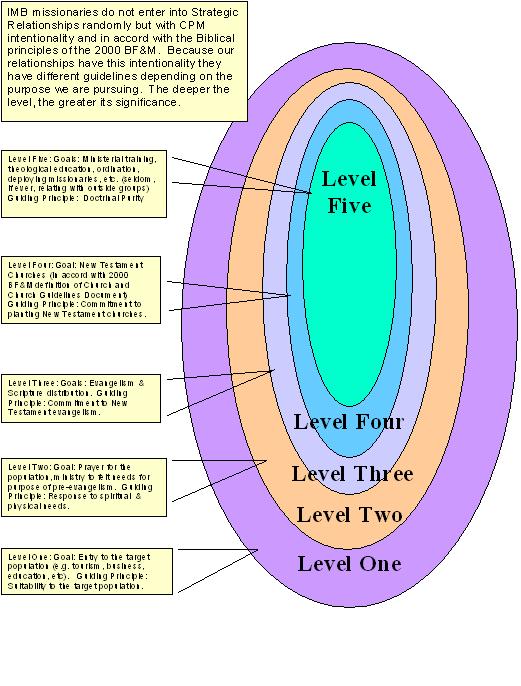
The key to understanding how best to partner with non-Baptists is first to define your goals and then identify the different partners who might contribute to these. Partnerships are not all the same. Some are fleeting in nature, barely even relationships. Others are much deeper and have eternal consequences. So it is with missions. The International Mission Board has identified five levels of relationships between IMB personnel and non-IMB entities. Let's look at them more closely.

Level One: This is the most superficial level of partnering, but it does serve a valuable purpose. Its aim is to gain initial access to a people group or population segment. Its governing principle is acceptability to people you're trying to reach. At this level, a missionary is trying to make inroads into what may be a hostile situation. Creativity and flexibility on the part of the missionary are essential.

Over the past year, many IMB missionaries have reported incidents of high government officials opening the doors to their cities or countries to teams of mission volunteers by hosting cultural festivals, educational programs or business fairs. These creative partnerships generally aren't even with believers, but they achieve the purpose of providing initial access to the people group. Level-one relationships often are with government departments, which serve as gatekeepers to the society as a whole. Once these gates are opened, the way is clear for deeper levels of relationships to follow.

Level Two: At this level, the missionary has taken his ministry to the next strategic step. The aim may be prayer for the people group or for ministry to its physical needs. The governing principle is suitability to the needs of the people being considered. The partnership may include anyone who wishes to help address these physical needs or to pray for these spiritual needs. Thus, the net of potential co-laborers is still cast far and wide.

When prayer is the aim, missionaries at this level haven't hesitated to invite any Christian believer to pray for the spiritual needs of their people group. In addition to specific and well-known prayer networks, missionaries have submitted prayer-profile requests directly to Internet prayer sites. The result is that thousands of unknown partners are able to engage in the ministry of prayer at level two.

For ministry, missionaries at level-two relationships often have partnered with secular agencies such as the United Nations High Commission for Refugees or the International Red Cross. While our ultimate agenda differs from theirs, partnering with them at this level allows us access and a redemptive touch in Jesus' name.

Level Three: Level three takes the ministry beyond prayer and physical ministry to the point of gospel presentation. For this reason, the governing principle of who we will partner with is a mutual commitment to New Testament evangelism. Accordingly, the net of potential co-laborers has been greatly reduced. One would not look to the United Nations or Red Cross for this type of partnership. Instead, the missionary calls on those evangelical colleagues who are able to present the good news of Jesus Christ in a clear and relevant manner.

Increasingly, missionaries are reporting many examples of level-three partnerships as they engage in evangelism projects with such agencies as TransWorld Radio, Campus Crusade for Christ, Operation Mobilization, Youth With A Mission and many, many others. Often these evangelism partnerships involve local bodies of believers including our Baptist brothers and sisters. Likewise, a growing pool of co-laborers is coming from agencies and independent Bible churches that have sprung-up in non-Western countries. The result of these level-three partnerships has been a manifold increase in the evangelization of lost peoples around the world. This increase in evangelization has set the stage for the next level of partnering.

Level Four: At level four, the aim is church planting. Here the principle governing who we work with is the New Testament model for a church. For us, this is synonymous with a Baptist or baptistic church model . At this level, the scope of potential partners is further reduced. Christian agencies and individuals that support evangelism without regard for church starting are less helpful at this level. Likewise, many Protestant denominations, if they don't advocate believer's baptism, would be unacceptable, because they wouldn't have a New Testament church model in mind. Baptist missionaries also hesitate to partner with fellow evangelicals if they conclude that their teaching distorts the gospel by emphasizing one aspect of the church at the expense of the whole. This still leaves an ample pool of colleagues with whom to co-labor around the world.

Level Five: At level five, the missionary's aim is to create ongoing structures and institutions that will shape the future of Christianity among a people. These ongoing structures address such matters as theological education and missionary-sending structures. Because the aim of level-five relationships has implications that would carry on even after the missionary is gone, the governing principle must be narrowly focused. Nothing less than an uncompromising commitment to doctrinal orthodoxy is acceptable. Thus, the scope of potential partners defines itself.

Even though the governing principle is tight, missionaries around the world have reported a wide-array of resources from which to draw. I look for resources that are solidly Bible-based, is a typical response. Missionaries find these from within and beyond the fold of the Southern Baptist Convention. At each point, however, their guiding principle is the same: Does this potential partner or curriculum hold firmly to the Word of God?

These five levels of relationships are not intended to be exhaustive but a descriptive snapshot of what Southern Baptist missionaries are currently engaged in around the world. They also are instructive for any of our personnel wanting to know what boundaries have been charted in relating to non-IMB individuals and agencies.

Most importantly, these levels point to a growing reality that is emerging on our mission fields. Southern Baptist missionaries increasingly are partnering with others to fulfill the Great Commission. We're not alone! In truth, we've never been alone. Christ always has been there with us. Today, however, we are seeing more clearly how He is at work through us and through others all around us.

IMB Relationships Levels, Goals & Guidelines

IMB missionaries relate to non-IMB entities at different levels depending on their goals and needs. These relationships range from expedient to eternal in their significance. The deeper the level, the greater its significance.

Level One:

Goal: Entry to the target population (e.g. tourism, business, education, etc.).
Guiding Principle: Suitability to the target poplulation.

Level Two:

Goal: Prayer for the population, ministry to felt needs for purpose of pre-evangelism.
Guiding Principle: Response to spiritual & physical needs.

Level Three:

Goal: Evangelism & Scripture distribution.
Guiding Principle: Commitment to biblical evangelism.

Level Four:

Goal: New Testament Churches (i.e. Baptist or baptistic).
Guiding Principle: Commitment to planting New Testament churches.

Level Five:

Goal: Ministerial training, theological education, ordination, deploying missionaries, etc.
Guiding Principle: Doctrinal Purity.
I would ask you to remember that what you have just read is the original policy related to working with GCCs and New Directions. What now follows is the new policy passed in May 2005 in which some significant changes were made…

IMB STRATEGIC RELATIONSHIPS
Goals and Guidelines

Level One. This represents the level in which our aim is simply to gain a presence or access to a people group or population segment. The missionary may be trying to make inroads into what may be a hostile situation. Creativity and flexibility are essential in associating with cultural programs, educational institutions, business forums or whatever can open the door to deeper levels of relationships. The key in these relationships is accessibility to the people the missionary is trying to reach.

Level Two. This represents the level in which we seek to minister to specific needs and mobilize prayer networks. Organizations that have a Christian identity and are motivated by spiritual principles may become co-workers in disaster response and in accessing restricted people through social and developmental ministries. We have not hesitated to invite and encourage any Christian believer to pray for the spiritual needs of a people group through prayer networks on the internet and other relationships.

Level Three. This level takes our relationships beyond prayer and ministry to physical needs to the point of gospel presentation. Accordingly the extent of potential co-laborers is greatly reduced to those whose commitment is to New Testament evangelism and who present personal repentance and faith in Jesus Christ as the only way of salvation. Such relationships usually reflect an encouragement to each organization to contribute what they can to the total effort, whether radio broadcasts like TransWorld Radio, literature distribution like Operation Mobilization or evangelism and discipleship training like the Navigators or Evangelism Explosion.

Level Four. This is the level of actually planting New Testament Churches, and the scope of relationships would be even further reduced and restricted. Individual teams relate with individuals and/or agencies in alignment with the definition of church as stated in the 2000 Baptist Faith and Message and the Church Definition and Guidelines document approved by trustees in January 2005.

Level Five. This is the level at which we are seeking to influence the ongoing shape of Baptist work and identity, even after the missionary is no longer present, through theological education and ministerial training. Seldom, if ever, would we engage in strategic relationships, even with other Great Commission Christians, at this level though we sometimes find ourselves with opportunities to relate to indigenous institutions in which others may already be working.
I believe it is significant that the term “baptistic” was not mentioned in the new document at Level Four. Perhaps, as others have inferred, the term “baptistic” is too vague, and means different things to different people. In any case, I also think it is significant that neither Something New Under the Sun, nor “IMB STRATEGIC RELATIONSHIPS: Goals and Guidelines,” strictly speaking, limits cooperation in church planting to groups clearly identified as “Baptists”.

What I would like to point out, however, from a missionary perspective, is the practical difficulty, in many situations, in dividing between Levels 3, 4 & 5. First of all, when you are doing “hands on” church planting, it is almost impossible to say anything you do is strictly “evangelism” and does not enter into the “church planting” realm. In the church plants in which we have had the privilege to participate, evangelism, discipleship, and leadership training, are all intermingled together at various stages of the church planting process.

Perhaps what is intended is that significant input into the doctrinal directions of the new churches planted be limited to those in agreement with the “Church Definition and Guidelines” document. And I can see why we would want the “input” we are funding and supporting as Southern Baptists to be in agreement with our doctrinal convictions. However, I think it is important to realize, at the same time, that true “Church Planting Movements” cannot be contained within denominational structures.

Under “New Directions”, the role of the missionary is less and less that of “hands on” church planter, and more and more that of “facilitator” of CPMs. This is perhaps a subtle distinction that is hard for many that have not lived on the mission field to understand. In a true “Church Planting Movement”, we are told, the original church planters will have little or no contact with the 3rd and 4th generation church plants, and thus no direct control over them. It is even debatable to what degree, if any, we as church planters should “control” the new churches we ourselves are planting. Yes, we have influence, and significant influence, at that. But “control” is a different matter.

One of the main principles of “New Directions”, which has deeply impacted my own ministry in Spain, and in which I believe deeply, is the following…

Impacting and “reaching” an entire people group with the Gospel, and seeing CPMs started among them, is a God-sized task. It is much bigger than any of our individual ministries, and much bigger than what we as the IMB, or as Baptists, can do by ourselves. It requires the participation and cooperation of the entire Body of Christ, both locally and globally. Missions research has demonstrated that when God’s people, from differing backgrounds and organizational affiliations, have gotten together to pray, strategize, and join hands in ministry, there have been significant breakthroughs in church growth and multiplication.

In the midst of all of this, those with “baptistic” convictions regarding ecclesiology continue to teach what they understand the Scripture to teach regarding ecclesiology, those from Pentecostal and Charismatic backgrounds will continue to teach what they believe regarding the gifts and ministry of the Holy Spirit, etc.

But, in my opinion, if the emphasis is on separation and denominational distinctives, and technical definitions of Levels 3, 4 and 5, rather than the overarching unity and cooperation of the Body of Christ at large, the dynamic of growth and spiritual advance of the movement suffers as a result.

It is because of this that I prefer the 5-level diagram drawn as follows. The differences are a thick black line in between Level 1 and the rest, in order to emphasize the essential unity that brings us together as born-again believers in the Lord Jesus Christ. In my opinion, the differences on either side of this line are much greater than those between the various levels on the inside of this line. Also, I have changed the lines dividing between levels 2, 3, 4 & 5 to “dotted” lines, in order to signify the flexibility and fluidity that I believe ought to exist when seeking to put into practice these general principles. I think the general principles, dividing between these levels are completely valid, and ought to serve as legitimate guidelines. But when missionaries feel they have to continually be looking over their backs to see who may be looking, and may call them down, for cooperating too widely with other born-again Christians, I think we are in danger of quenching the work of the Holy Spirit.


In closing, I would like to clarify I am not criticizing the new policy. In essence, I think it is a good policy. I am just warning of what I consider a danger of misusing this policy as a club to hinder spiritually committed and effective missionaries from carrying out the ministry God has called them to do.

Saturday, May 27, 2006

Historical Documents: Baptist-Evangelical Cooperation in World Missions, Part 13

In 2003, Keith Eitel, at that time Professor of Christian Missions at Southeastern Seminary, and presently Dean of the School of Evangelism and Missions at Southwestern, wrote a paper entitled "Vision Assessment: The International Mission Board of the Southern Baptist Convention." This paper was later distributed, together with a cover letter from Paige Patterson to all of the IMB Trustees. The context of the distribution of this letter was reported here in the North Carolina Baptist Biblical Recorder.

You can read the entire text here. But I would like to highlight a few quotes, especially in the context of our series on Historical Documents: Baptist-Evangelical Cooperation. Normally, perhaps, an "in-house" document like this, addressed to a relatively small group of people, would not merit much discussion when talking about strategically significant Historical Documents spanning such a long period of time. I am discussing it, however, in this series, because I believe that it (or at least the ideas contained therein) has been quite influential in the adoption of recent policies and strategy directions advocated by the IMB Board of Trustees.

First of all, Eitel begins with a quote of Keith Parks, in which he contrasts the theological perspectives of my father, as well as Paige Patterson, and his own, in relation to missions.

Early on I would argue with Adrian Rogers about that [basis for unity in the SBC] and he’d say no, ‘the theme that has held us together is not missions, but doctrine.’ Well, historically I don’t think that’s accurate because historically the SBC is composed of people with varying theological perspectives . . . . My assessment is that they’re [conservatives in the SBC] from an independent Baptist viewpoint where conventions are built around doctrine [sic] than from the heritage that we as Southern Baptists have had that the convention is builtaround missions. And so after arguing with Adrian several times, I finally came to realize that for him and I think for Paige [Patterson] and for others the unifying element ought to be a unifying perspective of theology . . . according to the Scripture, the Living Word is more important than the written word . . . it’s a mistake in my estimation to elevate Scripture above Christ . . .
Eitel later adds the following remarks: In essence, Parks was saying that doctrine or theology divides us but missions unites us. Rodgers (sic), however, was indicating that unless our theological convictions are solidly established squarely on an inerrant Bible, we will have no legitimate or reasonable basis for doing missions.
I certainly do not side with Parks on these points. I agree completely with my father in insisting that, when we dilute our theological underpinnings based on the authority of God’s Word, we lose the basis from which our commitment to world missions flows. However, I believe at the same time that Eitel went a bit overboard, using my father’s name and views as an emotional support to his arguments expressed later in his paper, many of which I am convinced my father would not have completely agreed with.

Next, I would like to comment on the following quote from Eitel’s paper…

The Parks attitude seems pervasive within the day-to-day operations of the International Mission Board [IMB] and represents the greatest future challenge to redirect Biblically the IMB and re-root it firmly in the older theological heritage of the founding fathers and its contemporary conservative commitments.

In the final analysis, the "New Directions" campaign seems to reflect the same theological position inherited from the Parks era. Theological definition is minimized and that which is "new" reveals it’s (sic) roots in the very theological heritage that influenced Parks to conclude that doctrine divides and missions unites.
In my opinion, Jerry Rankin himself has already done an admirable job at answering this accusation. While I have not been able to find the exact text of the response letter, here is an article by Associated Baptist Press writer Mark Wingfield, and posted in the North Carolina Baptist "Biblical Recorder", that gives a good summary.

I would also like to comment briefly on the following paragraph in Eitel’s paper…


While advancing toward the same stated goals in the Bold Mission Thrust campaign, Parks was influenced by trends among other Christian agencies. He advocated the use of strategic planning techniques and invited David B. Barrett, author of the World Christian Encyclopedia, into the Board’s facilities in Richmond. Barrett’s own Anglican theological persuasions are far more ecumenical than those traditionally held by Southern Baptists. Barrett quietly influenced several strategic planners at the Board and his methods were used to analyze the remaining task of global evangelization. It was not until the early 1990’s that Barrett was removed from the Board, yet his influence still lingers in the office of strategic planning and research to this day.
I would generally agree with Eitel that the perspective of Barrett is a good bit more ecumenical than that of most conservative evangelical Southern Baptists. I myself, having worked for the past 16 years in Spain, a country with a spiritual heritage very influenced by Roman Catholicism, have been concerned with how the theological biases of Barrett and others like him, are leading many to de-emphasize the priority of evangelism in Catholic contexts. At the same time, I recognize the positive contribution made by Barrett in objectively analyzing the comparative spiritual need of different areas of the world and people groups, and encouraging evangelicals to work together in order to see the Great Commission fulfilled. It is my contention, that if the influence of Barrett "still lingers in the office of strategic planning and research," this influence is mostly limited to the more positive aspects of Barrett’s contribution. I have never sensed, under Jerry Rankin’s leadership at the IMB, anything insinuating that Roman Catholics were not legitimate "targets" of our evangelistic efforts.

Now, more directly on the subject at hand, I would like to present the following quotes from Eitel’s paper regarding IMB cooperation with "Great Commission Christians"...

Yet, as the Board began to work in and with the broader Neo-Evangelical groups (now called Great Commission Christians), the cross-pollination of ideas without a careful analysis of the biblical and theological soundness of the trends that depicted the end of the last century missions world, began to erode even further the commitments Southern Baptists have historically had to a real need for personal evangelism, church planting, and discipleship of the nations.

I am in agreement regarding partnering with agencies of like theological persuasion for some tasks at home or abroad. However, I sense there’s no real mechanism in place to help missionaries evaluate the theological commitments of the plethora of groups that work around the world and certainly no incentive to guard themselves from unnecessary entanglements with charismatic people or agencies. Incidentally, the first time I heard the term Great Commission Christian was from the mouth of David Barrett as he was explaining to me how, in his opinion, Mormons are GCCs!

Rankin’s "New Directions" campaign drew the Board more directly into the network of GCC’s, again with no mechanisms in place to filter or check the entry of unbiblical practices other than the specific theological preparation of the individual missionary.

It raises serious questions regarding whether the end justifies the means when the types of churches planted increasingly do not reflect a biblical ecclesiology, Baptist values, or in some cases even appear Christian.
Also, from Eitel’s list of recommendations at the end of his paper, the following…


Generate theological definitions and boundaries for partnering with GCC’s, review the nature of the SC/SL position and create alternatives suitable for women that are in line with the sentiments of the BF&M 2000, and create guidelines for church planting that will insure healthy theological development and be reflective of Baptist distinctives.

    First off, Eitel seems to follow Patterson’s lead (as referenced in The Church in the 21st Century) in throwing groups with widely divergent beliefs and practices into the "Great Commission Christian" sack ("Neo-evangelical groups", "charismatic people and agencies", and even "Mormons" and "churches" that do not "even appear Christian"). The impression left is all are "guilty by association."

    I would also question Eitel’s suggestion that more seminary education is the best corrective for missionaries unprepared to deal with the theological subtleties involved in working with the "GCC world". Most assuredly, there is an important place on the mission field for those gifted in missiological and theological reflection. However, in my experience, a seminary degree is far from a guarantee for this. Some of the most gifted and effective workers I know have not completed a seminary degree. It has been my observation that those who have been most successful in North American ecclesiological and training models many times are the ones who later have the most difficulty in "thinking outside of the box" in order to reach people more effectively in other cultural contexts.

    I myself have an M. Div. from Southwestern Seminary, (which includes almost 2 years worth of transfer credits from Mid-America Seminary), and probably read up on missiological and theological issues more than the average IMB missionary. Yet I would not say this has influenced me to be any narrower in my dealings with other GCCs. If anything, I would venture to say, it has pointed me in the contrary direction.

    Now, if what is being advocated is indoctrination and teaching "cookie-cutter" approaches to missions at our seminaries, perhaps with time we would have a more "lock-step" contingent of IMB workers. If, however, we are looking for an effective "incentive to guard [IMB workers] from unnecessary entanglements", I would neither suggest this, nor generating narrower "theological definitions and boundaries for partnering with GCCs", as the solution.

    A better plan, in my opinion, is to open the forum of discussion among those who have the most at stake: the missionaries themselves. Under "New Directions", this is precisely what is already happening. We as missionaries are being encouraged to go back to the Bible (not just denominational tradition) to find our definitions for church and to seriously reflect upon how to best flesh this out in the particular cultural context in which God has led each of us to work.

    As a result of this (and certainly many other factors as well), I believe, we are seeing great breakthroughs in many parts of the world in terms of evangelism and church planting. Yes, perhaps, there are isolated cases of things getting a bit "out of hand" from time to time. But, in my opinion, the dangers of putting a damper on, and encouraging a more restrictive and inquisitorial mindset in regards to "New Directions" and our cooperation with other GCCs, is by far the greater danger. IMB missionaries, as a whole, love God, the Bible, and lost souls as much as anyone. And I believe we, as a result of the unique experiences and calling God has given us (together with the strategic input of all of those God has gifted throughout his entire Body), are the most qualified to determine how best to make disciples of all the peoples of the world.